

What happens to the center seat belt during a collision test?
In the automotive safety industry, seat belts are a fundamental component, playing a pivotal role in protecting passengers during collisions. As a center seat belt supplier, I've witnessed firsthand the importance of these safety devices and have delved deep into understanding what happens to a center seat belt during a collision test.
Understanding the Center Seat Belt
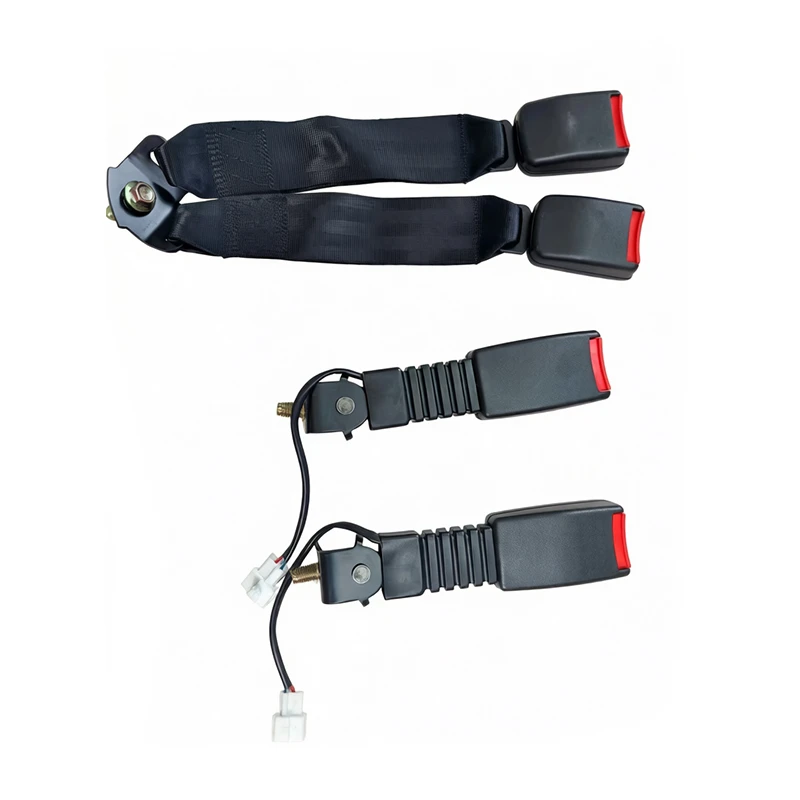
Before we dive into the details of collision tests, let's first understand the nature and purpose of a center seat belt. Unlike the side seat belts, the center seat belt is typically located in the middle of the rear or front row of a vehicle. It serves to safeguard the passenger sitting in that central position, who might otherwise be at greater risk due to the lack of lateral protection from the vehicle's structure.
The design of center seat belts can vary. Some are lap belts only, which secure the lower body, while others are three - point belts that also include a shoulder strap for additional upper - body restraint. Three - point center seat belts are generally more effective in providing comprehensive protection, as they distribute the force of impact across multiple parts of the body.
The Collision Test Setup
Collision tests are conducted under strict and controlled conditions to accurately evaluate the performance of safety components like seat belts. There are different types of collision tests, such as frontal, side, and rear - end collisions. For center seat belts, frontal collision tests are among the most common and revealing.
In a frontal collision test, a vehicle is propelled towards a fixed barrier at a specific speed, usually ranging from 30 to 50 miles per hour. Inside the vehicle, anthropomorphic test devices (ATDs), also known as crash test dummies, are placed in the seats. These dummies are equipped with sensors that measure various parameters such as acceleration, force, and displacement during the impact.
What Happens to the Center Seat Belt During a Frontal Collision Test
Pretensioning Phase
When a collision is detected, the seat belt system's pretensioner is activated. Pretensioners are mechanisms that quickly retract the seat belt to remove any slack. In the case of a center seat belt, this is crucial as it ensures that the passenger is firmly held in place right from the start of the impact. The pretensioner works in a fraction of a second, reducing the forward movement of the passenger and minimizing the risk of hitting the interior of the vehicle.
Force Limiting Phase
After the pretensioning phase, the force limiter comes into play. The force limiter is designed to control the amount of force exerted on the passenger by the seat belt. During a collision, the deceleration of the vehicle is extremely high, and if the seat belt were to hold the passenger rigidly, it could cause serious internal injuries. The force limiter allows the seat belt to extend slightly in a controlled manner, gradually dissipating the energy of the impact and reducing the peak force on the passenger's body.
Belt Webbing Behavior
The belt webbing of the center seat belt also undergoes significant stress during a collision. High - quality seat belt webbing is made of strong and durable materials, such as nylon. During the impact, the webbing stretches slightly, absorbing some of the energy of the collision. However, it must also maintain its integrity and not tear or break. If the webbing fails, the seat belt will lose its ability to restrain the passenger effectively.
Interaction with the Passenger
The center seat belt interacts with the passenger in a complex way during a collision. In the case of a three - point belt, the lap belt portion restrains the lower body, preventing the passenger from sliding forward and hitting the dashboard or the back of the front seat. The shoulder strap, on the other hand, restricts the upper - body movement, reducing the risk of head and neck injuries.
However, if the passenger is not wearing the seat belt correctly, for example, if the shoulder strap is placed behind the back, the effectiveness of the seat belt is greatly reduced. During a collision test, researchers also study how different seating positions and passenger postures affect the performance of the center seat belt.
The Impact of Different Vehicle Designs
The performance of the center seat belt during a collision test can also be influenced by the design of the vehicle. For example, vehicles with a more rigid body structure can transfer the impact forces more efficiently, reducing the stress on the seat belt. In contrast, vehicles with a softer structure may experience more deformation during a collision, which can put additional strain on the center seat belt.
The mounting points of the center seat belt also play a crucial role. If the mounting points are not strong enough, they may fail during a collision, causing the seat belt to lose its effectiveness. Therefore, vehicle manufacturers must ensure that the mounting points are properly designed and reinforced to withstand the forces generated during a collision.
The Role of Seat Belt Technology Advancements
Over the years, there have been significant advancements in seat belt technology, which have also improved the performance of center seat belts during collision tests.
One such advancement is the development of new materials for seat belt webbing. As mentioned earlier, nylon is a common material, but recent research has focused on using stronger and more lightweight materials, such as high - strength polymers. These materials can provide better energy absorption and are more resistant to tearing.
Another innovation is the integration of electronic sensors and active safety systems with seat belts. For example, some seat belts can be pre - tightened based on the detection of an imminent collision by the vehicle's safety sensors. This allows for more precise and timely pretensioning, enhancing the protection of the passenger.
Real - World Implications
The results of collision tests on center seat belts have far - reaching real - world implications. By understanding how center seat belts perform during collisions, we can improve their design and safety features, ultimately saving lives.
For vehicle manufacturers, the data from collision tests help them meet safety standards and regulations. Many countries have strict safety requirements for seat belts, and passing collision tests is a necessary step for vehicle certification.
As a center seat belt supplier, we are committed to providing high - quality products that meet or exceed these safety standards. We offer a wide range of seat belts, including Universal Seat Belts for Cars, Yellow Safety Belt, Rear Seat Belt in Car, Blue Car Seat Belts, and Seat Belt For Rear Seats. Our products are designed to provide optimal protection in various collision scenarios.
Conclusion
In conclusion, the center seat belt undergoes a series of complex processes during a collision test. From pretensioning to force limiting, the seat belt system is designed to protect the passenger by minimizing the effects of the impact. Vehicle design and technological advancements also play important roles in enhancing the performance of the center seat belt.
If you are interested in our high - quality center seat belts or have any questions about seat belt safety, please don't hesitate to contact us for procurement and further discussions.

References
- Stombaugh, G., & Montanan, D. (2015). Seat Belt Technology Review. SAE International.
- National Highway Traffic Safety Administration. (2021). Federal Motor Vehicle Safety Standards and Regulations.